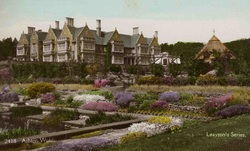
Ashton Wold, Northamptonshire, England
The Ashton Estate was originally purchased by Baron Lionel de Rothschild (1808-1879) in 1860. According to family legend, his grandson Charles Rothschild (1877-1923) fell in love with the Northamptonshire countryside where he was searching for butterflies. An ardent and knowledgeable lepidopterist, he was enchanted by the Ashton woodlands, with their abundant old sallow bushes and attendant Hair-streaks, rare butterflies whose larvae feed on ancient sallow.
Intrigued by an empty Elizabethan house, Charles is said to have enquired of a local inn as to the owner of the Ashton woodlands and was dismayed to learn that the land was owned by a family that (so it was said) rarely sold property and rarely needed to sell property. Upon further investigation, he discovered that the owner, was in fact, his father Natty, (Nathaniel 1st Lord Rothschild (1840-1915), who had regarded the Ashton Estate as inconsequential and hardly worthy of note.
The house was in a hollow and so deemed bad for the health, which is possibly why it had remained vacant. However, Charles persuaded his father to make it over to him, and he commissioned the architect William Huckvale, who had worked on Rothschild properties at Tring, to build him a new house. Huckvale designed a rambling, Tudor-style manor house with a succession of gables and very large and pretty Elizabethan windows as a reminder of the original property.
Charles, the founder of the Society for the Promotion of Nature Reserves, managed the Ashton Wold estate to maximise its suitability for wildlife, especially butterflies. In the village, local stone and thatched roofs were used to reconstruct the cottages which were provided with running water, bathrooms and large gardens; construction of estate cottages was a particular interest of Huckvale and he created a model village settlement at Charles’ request. Many of the Edwardian cottages surviving on the estate today are examples of Huckvale’s work.
In 1918, Charles succeeded his uncle Alfred (1842-1918) as Senior Partner of N M Rothschild & Sons, and he and his wife Rozsika (1870-1940), with the their four children Miriam, Liberty, Victor and Nica divided their time between Arundel House in Kensington and the Ashton estate.
Ashton Wold and Dame Miriam Rothschild
After Charles’ untimely death in 1923, his widow Rozsika modified the main manor house, reducing its height to two storeys. Miriam Rothschild (1908-2005) inherited the house after her parents’ deaths. During the Second World War, Miriam pressed the UK Government to allow more German Jews as refugees from Nazi Germany and set up housing for 49 Jewish children. The Ashton Wold estate served as a hospital for wounded military personnel, including Miriam's future husband, Captain George Lane (1915-2010). Accommodation blocks were also constructed in the Ashton Wold woods for the RAF and the American Eighth Air Force billeted at nearby Polebrook Airfield.
Miriam continued her late father’s passionate stewardship of the estate and the gardens she created and nurtured at Ashton were described as ‘an outstanding example of wildflower and grassland gardening’. Her expertise in nature conservancy led to her advising HRH Prince Charles, the Prince of Wales when he was creating an experimental wildflower meadow at his Highgrove Estate. In her book, The Rothschild Gardens (London: Gaia Books, 1996), Miriam described her passion for the gardens.
The Ashton estate today
Today, the manor house and its garden are listed on the Register of Historic Parks and Gardens by English Heritage for their historic interest, and part of the garden is woodland which is designated as Ashton Wold Site of Special scientific Interest. The SSSI is ancient secondary woodland with mature oak, ash and birch trees. The thick shrub layer includes hawthorn and buckthorn. There are breeding birds such as woodcocks and hawfinches. Part of the estate is the subject of a Restrictive Covenant between Charles's daughter Miriam Rothschild and the National Trust in 1945.
Following the death of Dame Miriam Rothschild in 2005, the Ashton Estate is managed by OHL Limited on behalf of her descendants, and no members of the family reside on the Ashton Estate, although the family own a large majority of the Estate and take a keen interest in the efficient running of the commercial operations whilst maintaining the long held family commitment to conserve the landscape and historic estate buildings. The Ashton Estate comprises residential properties, holiday accommodations (The Lady Rothschild Holiday Houses), agricultural land and a working farm. Access to the public is by written invitation only; the only exceptions to this are Public Rights of Way.
See also Ashton Wold estate, Polebrook Airfield and 'The Roughs', Oundle
For further information see the website The Ashton Estate (OHL Limited)
Return to Estates listing